
Every November, we celebrate Native American Heritage Month, a time to honor the rich histories, diverse cultures, and significant contributions of Native peoples across the United States. At the Library, we are proud to join in this national tribute by providing resources that highlight Indigenous voices and stories.
Voices of the First Peoples
Native American Heritage Month is more than a celebration—it’s a reminder of the enduring presence and influence of Indigenous communities. From art and literature to science, government, and environmental stewardship, Native Americans have shaped and enriched the fabric of American life for centuries.
As we celebrate Native American Heritage Month, we also take time to reflect on the land we inhabit and its original stewards. It is important to acknowledge that we Salinians are on the traditional lands of the Kansa (Kaw), Pawnee, and Arapaho, and later, the Cheyenne, Sioux, Delaware, and Potawatomi. It is up to us to honor their enduring connection to this place.
Explore Native Stories
Our library has curated a special collection of books, films, and digital resources for all ages that reflect the histories and experiences of Native communities. Whether you’re looking for children’s picture books by Indigenous authors, historical nonfiction, contemporary Native fiction, or Kansas-specific stories, there’s something for everyone.
Highlights from Our Collection:
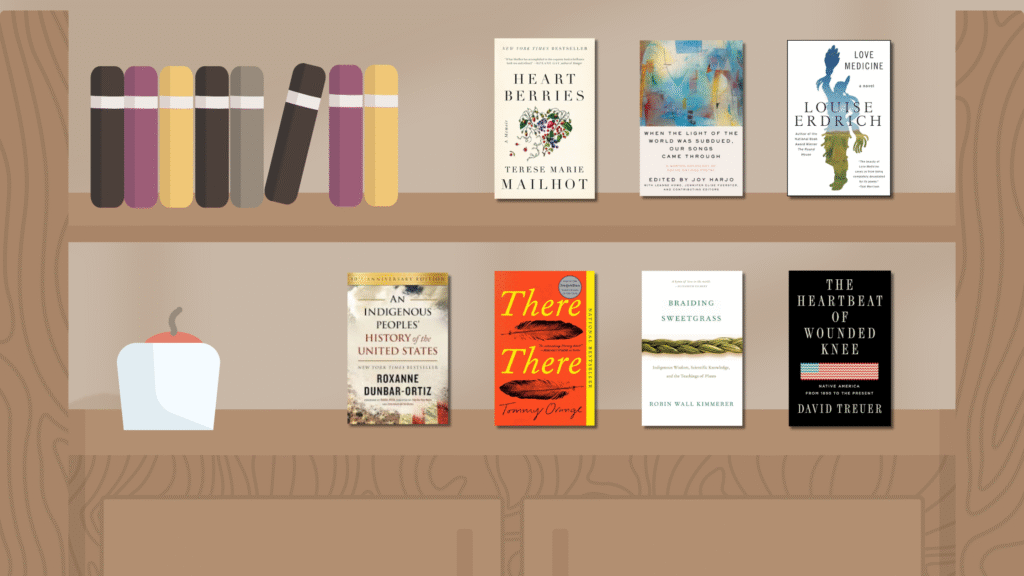
Braiding Sweetgrass: Indigenous Wisdom, Scientific Knowledge, and the Teachings of Plants by Robin Wall Kimmerer
A lyrical blend of memoir, science, and Indigenous philosophy that explores the deep relationships between humans and the natural world. Through stories and ecological insight, Kimmerer invites readers to see plants as teachers and to embrace reciprocity, gratitude, and respect as guiding principles for living in balance with the Earth.
Note: The author has also produced a young adult version: Braiding Sweetgrass for Young Adults: Indigenous Wisdom, Scientific Knowledge, and the Teachings of Plants
An Indigenous Peoples’ History of the United States by Roxanne Dunbar-Ortiz
Reframes American history through the perspective of Indigenous nations, revealing how settler colonialism, land dispossession, and resistance shaped the country’s foundation. Drawing on historical records and Indigenous scholarship, Dunbar-Ortiz challenges national myths and centers Native voices in the ongoing story of the United States.
Note: There is also a version for younger readers: An indigenous peoples’ history of the United States for young people by Debbie Reece
There There by Tommy Orange
Follows twelve interconnected Native characters living in Oakland, California, as their stories converge at a community powwow. Through their diverse voices, this novel delves into identity, displacement, and resilience in contemporary urban Native life.
Love Medicine by Louise Erdrich
Traces the intertwined lives of several Ojibwe families over multiple generations on a North Dakota reservation. Blending humor, heartbreak, and spiritual depth, the novel explores themes of love, loss, and the enduring power of family and cultural identity.
When the light of the world was subdued, our songs came through: a Norton anthology of Native nations poetry – Joy Harjo, editor
A gathering of the voices of more than 160 poets from nearly 100 Indigenous nations across North America. Spanning centuries, the collection celebrates the resilience, beauty, and continuity of Native languages, stories, and songlines that illuminate the enduring spirit of Native poetry.
Heart Berries by Terese Marie Mailhot
A raw and lyrical memoir that chronicles the author’s journey through trauma, mental illness, and the complexities of love and identity as an Indigenous woman. With unflinching honesty and poetic intensity, Mailhot transforms pain into art, reclaiming her voice and power through storytelling.
The Heartbeat of Wounded Knee: Native America from 1890 to the Present by David Treuer
A challenge to the narrative that Native American history ended with the 1890 massacre at Wounded Knee. Blending history, reportage, and memoir, Treuer reveals the resilience, adaptation, and cultural vitality of Native peoples in the face of ongoing change and adversity.
Old School Indian by Aaron John Curtis
This novel follows Abe Jacobs, a 43-year-old Kanien’kehá:ka man from Ahkwesáhsne who has left his reservation only to return home when a rare and potentially fatal illness forces him to confront his fractured identity, marriage, and creative ambitions. Through his reluctant healing journey guided by his great-uncle Budge, Abe grapples with the weight of cultural loss, family secrets, and what it really means to belong.
House Made of Dawn by N. Scott Momaday
Follow Abel, a young Native American man who returns home from World War II and struggles to reconnect with his heritage and identity amid the alienation of modern life. Through lyrical prose and shifting perspectives, the novel explores themes of cultural dislocation, spiritual renewal, and the enduring power of tradition. This 50th-anniversary edition of Momaday’s Pulitzer Prize–winning masterpiece includes a newly written preface by the author.
The Only Good Indians by Stephen Graham Jones
Four Native American men are haunted by a violent event from their youth that has unleashed a relentless, supernatural force seeking revenge. Blending horror with social commentary, the novel explores guilt, cultural identity, and the inescapable weight of the past.
The Sentence by Louise Erdrich
This novel centers on Tookie, a Native American woman who works in a Minneapolis bookstore who becomes haunted by the ghost of its most annoying customer. Spanning from 2019 through the pandemic and the aftermath of George Floyd’s murder, the novel weaves together themes of grief, resilience, and the enduring power of books and community.
About The Author: Sarah
Sarah is an information services assistant at the Salina Public Library. She graduated from Kansas State University with a B.A. in Journalism & Mass Communication and a Masters of Arts in Teaching. Sarah also works as a 5th grade teacher when not working at the library. In her down time, Sarah enjoys being with her dogs, doing home projects, watching sports (Go Wildcats!), and learning new things. Her favorite thing about the library is the people, the patrons and her coworkers make it a great place to be at.
More posts by Sarah